A typical pKa determination involves titrating the solution of the molecule across a defined pH range, while continuously monitoring changes in a suitable physicochemical signal, most commonly via potentiometric or spectrophotometric measurements. In this setting, the measurement yields only a sequence of apparent transition values consistent with the measured pH range, but it does not directly identify the specific protonation states involved in each transition.
By contrast, even among the practitioners of relevant fields such as medicinal chemistry, biochemistry, and pharmaceutical sciences, there is often a limited awareness of the distinction between microscopic and macroscopic pKa values. Microscopic pKa values refer to the dissociation constants associated with specific protonation sites on a molecule, while macroscopic pKa values represent the overall protonation events between two charge states (such as -1 and 0), without specifying individual sites. This can lead to serious misconceptions, particularly in the case of multiprotic molecules. Importantly, a single charge state might exist as an equilibrium ensemble of microstates, making pKa values difficult to interpret, as experimental measurements typically yield macroscopic pKa values, while popular property predictor software usually calculate microscopic pKa values by default.
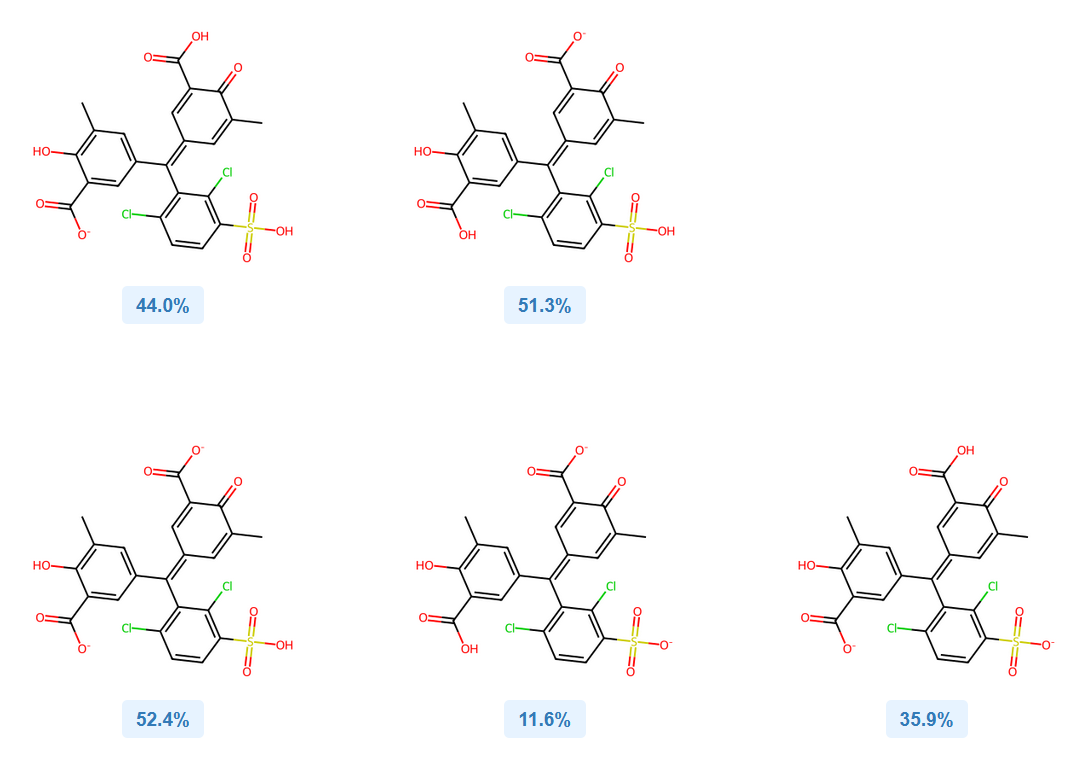
Assigning specific microscopic states to experimentally derived macroscopic constants is generally not straightforward, especially by experiment. A practical route to a more detailed description of the underlying transitions is therefore to align the experimental values with computationally predicted dissociation constants. Here, we aim to provide the community with the largest collection of experimentally determined macroscopic pKa values, with detailed information on the associated charge state transitions, to facilitate the development and benchmarking of pKa prediction methods, as well as any other downstream applications.
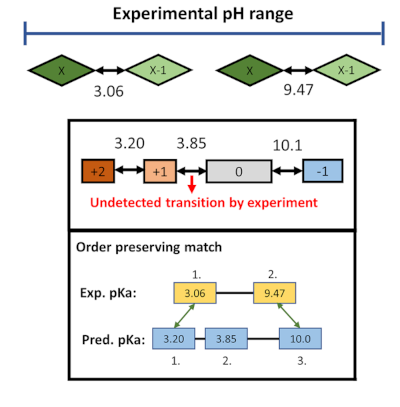
Here, charge state transition assignment was carried out for every experimental pKa value by matching them to calculated macroscopic pKa values by Epik. We used an order-preserving matching algorithm to pair experimental and predicted pKa values, minimizing the sum of absolute differences between them. The results can be browsed by individual molecules or datasets or downloaded in bulk.
If you use pKahub in your work, please cite our primary paper: To be published
pKahub is an open-source project, maintained by the Medicinal Chemistry Research Group (@keserulab) in Budapest, Hungary.
You can contribute to the project via GitHub:
You can contact us with any questions or suggestions regarding pKahub at pkahub
 ttk
ttk
 hu
hu